
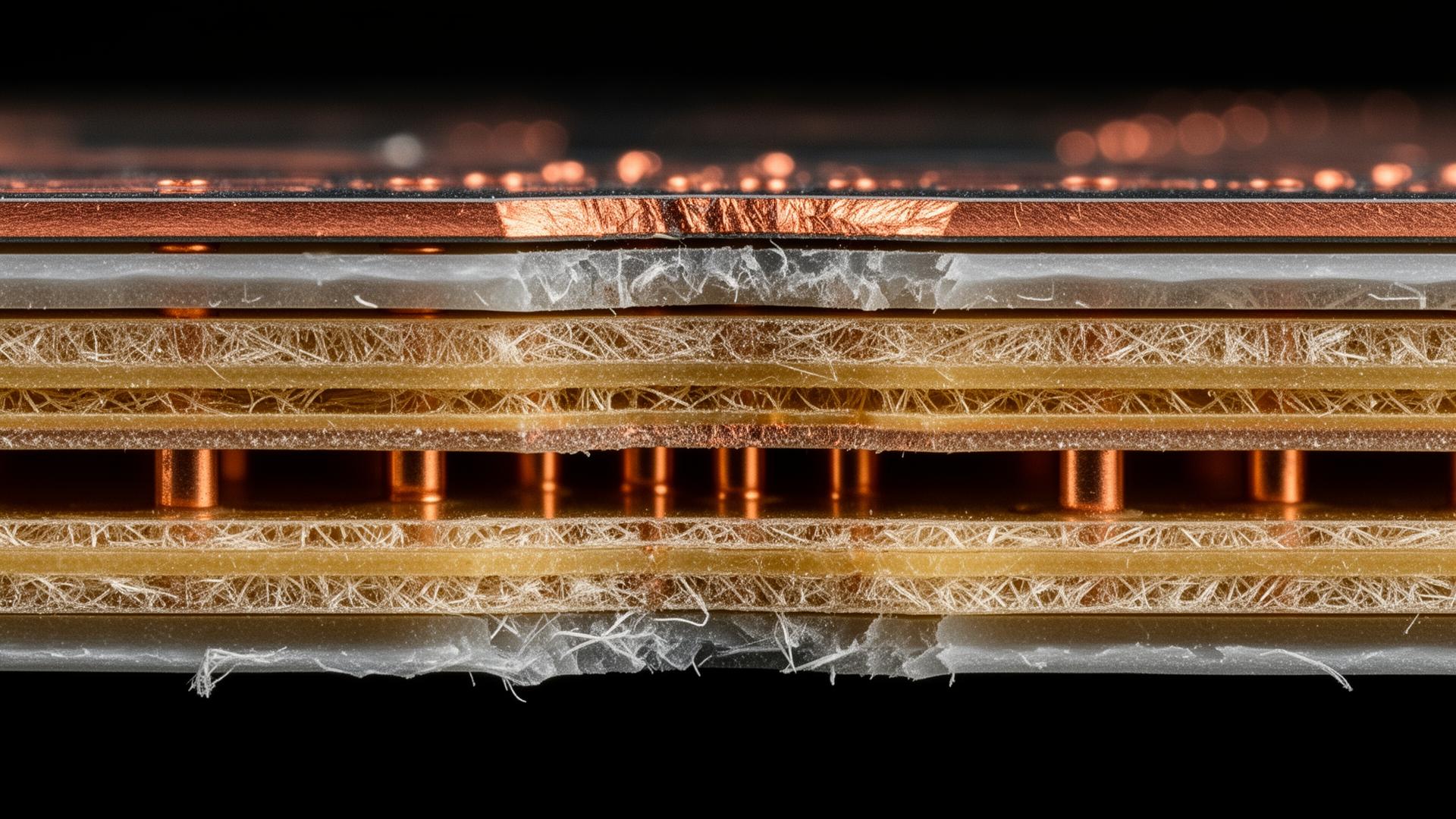
Macro cross-section of a multilayer PCB stackup showing copper layers, prepreg and FR-4 core
Substrate Selection Guide

PCB Materials

The right substrate decides whether your board is fast, thermally stable, and manufacturable at scale. Here is how SmartFab matches materials to use cases.

FR-4 (Standard & High-Tg)

The workhorse PCB substrate. Glass-reinforced epoxy laminate with excellent mechanical strength and good electrical performance for the vast majority of digital and mixed-signal designs.

Grades available

  • TG130 / TG140 standard
  • TG150 mid-range
  • TG170 / TG180 high-Tg for lead-free assembly and elevated thermal

Best for

  • Consumer electronics
  • Industrial controls
  • Most digital and analog designs
  • Multi-cycle reflow assemblies

Standard 1.6 mm boards in TG150 are SmartFab's default — fast, reliable, no upcharge.

Rogers RF Laminates

Low-loss, dimensionally stable substrates engineered for microwave and high-frequency designs. Tightly controlled dielectric constant (Dk) for predictable impedance.

Grades available

  • Rogers 4003C — woven glass, low-loss
  • Rogers 4350B — lead-free reflow compatible
  • Mixed FR-4 / Rogers hybrid stackups

Best for

  • 5G and mmWave radios
  • Radar and satcom
  • Antennas and RF front-ends
  • Test and measurement equipment

Hybrid stackups with Rogers on RF layers and FR-4 elsewhere keep cost down without compromising RF performance.

Aluminum MCPCB (Metal Core)

Aluminum core with a thin dielectric and copper layer on top. Pulls heat away from high-power components like LEDs and motor drivers.

Grades available

  • 1.0–3.2 mm aluminum cores
  • Single-sided copper
  • Thermally conductive dielectric (1.0–3.0 W/m·K)

Best for

  • LED lighting and luminaires
  • Power supplies
  • Motor drivers and inverters
  • Automotive lighting

When your hot components need a thermal exit, MCPCB beats heavy copper FR-4 in cost and performance.

Polyimide Flex

Thin, flexible polyimide film with rolled-annealed copper. Bend it, fold it, route it through tight enclosures.

Grades available

  • Single- and double-sided flex
  • 1- to 4-layer flex constructions
  • Coverlay or flexible solder mask

Best for

  • Wearables and medical sensors
  • Camera modules
  • Tight enclosures and hinges
  • Replacing wire harnesses

Flex eliminates connectors — fewer parts, fewer failure points, lower assembly cost at volume.

Rigid-Flex

Combined rigid and flex sections in a single board. The rigid sections hold components; the flex sections fold or route the assembly into 3D space.

Grades available

  • 2- to 12-layer rigid-flex
  • Asymmetric stackups
  • Stiffeners and selective coverlay

Best for

  • Aerospace and avionics
  • Defense electronics
  • Compact medical devices
  • Industrial robotics

Higher upfront NRE pays back in mechanical reliability and assembly simplicity over the product lifetime.

Not sure which substrate fits your build?

Configure your specs in the quote tool — our engineers review every order and will recommend the right material if anything looks off.

Start Your Quote